
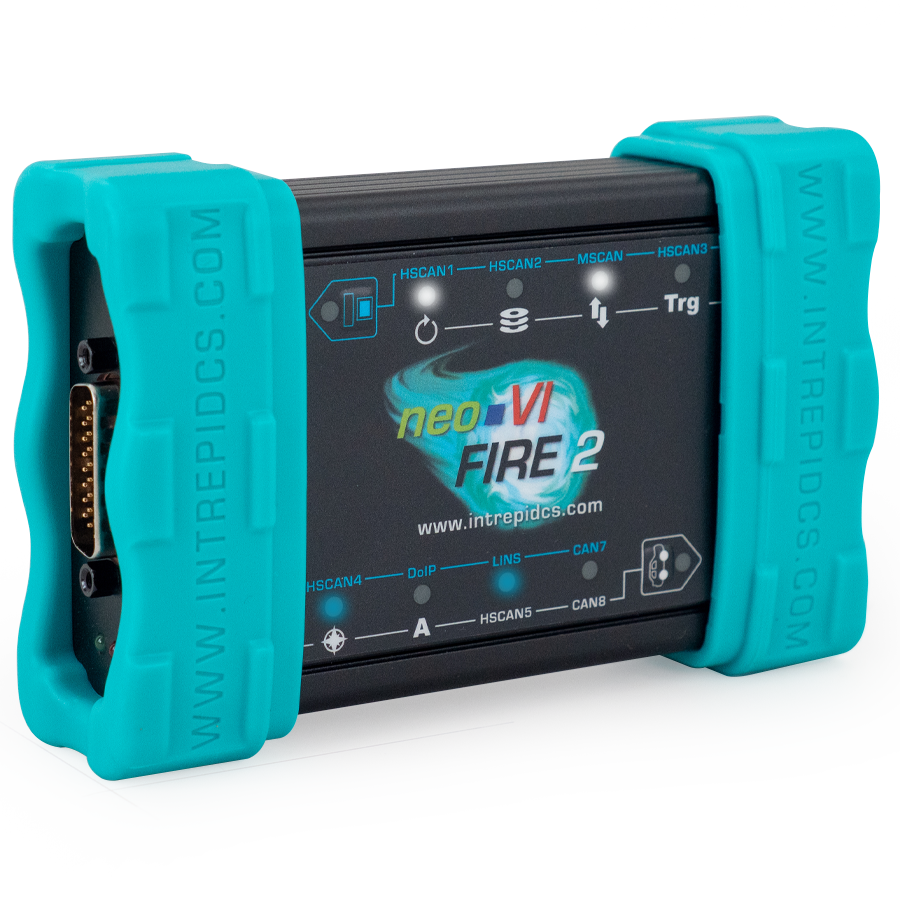


neoVI FIRE 2
- Does not include Vehicle Spy license.
- One license required per neoVI device.
- Vehicle Spy Enterprise required for DoIP/Ethernet.
Vehicle Interface &Data Logger: 8x CAN FD, 4x LIN, Ethernet: DoIP/XCP
The neoVI FIRE 2 provides Ethernet, eight channels of CAN (including CAN FD) and four channels of LIN in one tool. All channels run simultaneously and are time-stamped in hardware.
At a glance
- Compatibility26-pin male HD D-Sub and 9-pin micro D-Sub
- Key interfaces26-pin male HD D-Sub and 9-pin micro D-Sub; 10 Hz to 1 kHz, or based on digital change
- Included itemsNo bundled accessory list provided
- Lead timeUsually Ships in 1 to 2 Weeks
- Country of originUS
Modern vehicle architectures are expanding to include Ethernet and CAN FD in addition to existing CAN and LIN networks. The neoVI FIRE 2 provides Ethernet, eight channels of CAN (including CAN FD) and four channels of LIN in one tool. All channels run simultaneously and are time-stamped in hardware. A fully-isolated high-speed USB interface allows messages to be sent and received without risk of damage to the PC.
Stand-Alone Logging, Scripting, and Simulation
In addition to working as a PC interface, the neoVI FIRE 2 can operate in standalone mode. It can run real-time scripts, log data to a removable microSD card, and simulate ECUs and gateways. With these features, it is also possible to run a script to reflash ECUs using data from the microSD card.
neoVI DLL, J2534, Linux, and RP1210 Support
Since some users prefer to write their own software, the neoVI FIRE 2 supports three open APIs: neoVI DLL API, SAE J2534 API, and TMC RP1210 A/B. The neoVI DLL API includes examples for all popular development environments, including C#, VB.NET, VB6, Delphi, C++ Builder, Visual C++, LabVIEW, and LabWindows. Examples and drivers for both Windows and Linux are available.
Vehicle Spy Enterprise Software
Intrepid’s Vehicle Spy Enterprise software fully supports the neoVI FIRE 2. With Vehicle Spy, users can monitor and transmit on all neoVI FIRE 2 networks simultaneously. Vehicle Spy is required to configure standalone mode. Users can take advantage of the powerful interface to load databases and to write and debug scripts before downloading them to the device.
Hardware-in-the-Loop Real-Time Performance
The neoVI FIRE 2 includes a real-time scripting engine that can be used to perform real-time messaging. For example, an engineer creating an application can load a script into the hardware and interface with the script variables, allowing microsecond-level measurement and control. Through a new feature called hardware acceleration, Vehicle Spy can also be configured to send real-time functions to the device, such as periodic messaging, replay, or scripting.
Logging Features
The neoVI FIRE 2 is capable of logging to a removable microSD card, which uses a real-time, fail-safe FAT32 storage system for reliability and PC compatibility. The FIRE 2 also has a real-time clock to hardware timestamp all messages. Finally, a robust power management system automatically powers down the neoVI FIRE 2, and can wake the device again based on network activity or the connection of a PC.
The Evolution of the Original neoVI FIRE
While the neoVI FIRE 2 was developed primarily to provide new vehicle networks and features, it also provides significant improvements over its successful predecessor, the original neoVI FIRE. These include a more robust case and connectors, much larger script space, SD card data offload over USB, the ability to power the device from USB during configuration, support for a larger voltage range, and an expanded voltage range on MISC I/O channels.
| Fourth-generation neoVI architecture | over 10x the performance of earlier devices |
|---|---|
| Power Supply | 4.5-40V operation |
| LED membrane keypad | 10 full-color LEDs indicate network status; 2 LEDs for legacy status; 2 user buttons |
| Temperature Range | -40°C to +85°C |
| Vehicle connectors | 26-pin male HD D-Sub and 9-pin micro D-Sub |
| General Purpose IO | 2 MISC IO (0-40V) – can be configured as Analog/PWMIO |
| General purpose I/O rate report interval | 10 Hz to 1 kHz, or based on digital change |
| J2534 and RP1210 A/B compatible for CAN/ISO15765-2 | 2016 (CAN FD) |
| DW CAN mode | 2 dedicated ISO 11898 Dual Wire CAN FD physical layers (MCP2561FD) |
| LSFT CAN mode | 2 Low Speed Fault Tolerant CAN physical layers (TJA1055) |
| SW CAN mode | 2 Single Wire CAN physical layers GMW3089 / SAE J2411(MC33897) |
| LIN Bus Monitor Mode identifies errors | Sync Break Error State and Length, Sync Wave Error, Message ID parity, TFrameMax/Slave Not Responding, Checksum Error and Transmit Bit Errors |
| Harmonized Code | 9031808080 |
|---|---|
| ECCN | 5A991b |
| Unit of Measure | EA |
| Country of Origin | US |
EU EMC: EMC Directive (General); EN 61326-1; EN 55011; EN 61000- Series
RoHS: EU Directive 2011/65/EU; EU Directive 2015/863/EU